

By Karen Oberhauser
Update from Mexico: What do the Numbers Mean?
From early November until mid-March, most eastern North American migratory monarchs were in central Mexico, waiting to head back north to produce what will become the first new generation of 2026. Estela Romero of Journey North reported early departures in late February, and final massive departures on March 7 and 8. These monarchs, most of whom began their lives as eggs in monarchs’ northern breeding grounds last August and September, are now heading north, laying eggs along the way.
A team from CONANP (Comisión Nacional de Áreas Naturales Protegidas – the National Commission of Natural Protected Areas) and the World Wildlife Fund-Mexico measures the area occupied by monarchs throughout the winter. On March 17, they released data from the winter 2025–2026 monarch population counts. In December 2025, monarchs occupied 2.93 hectares (7.24 acres), compared to 1.79 hectares at the same time in 2024. This area is slightly higher than the average of 2.81 hectares over the past decade and represents a 64% increase over last year’s area.
Here’s my takeaway from this report: The increase is good news; it’s further evidence that the eastern North American migratory population is holding its own over the past decade, after a decade of decline from about 2003 to 2014 (see the graph below). I would argue that it is holding its own thanks to conservation efforts on the part of individuals and organizations throughout the breeding, migration, and overwintering ranges. There is, however, no evidence of an ongoing increase in numbers, despite all of these efforts; there are still forces pulling in the other direction—ongoing climate change, insecticide use, and continuing habitat loss to development and agriculture. Increasing the population size will require ongoing habitat creation and efforts to slow the forces that pull monarch numbers down.
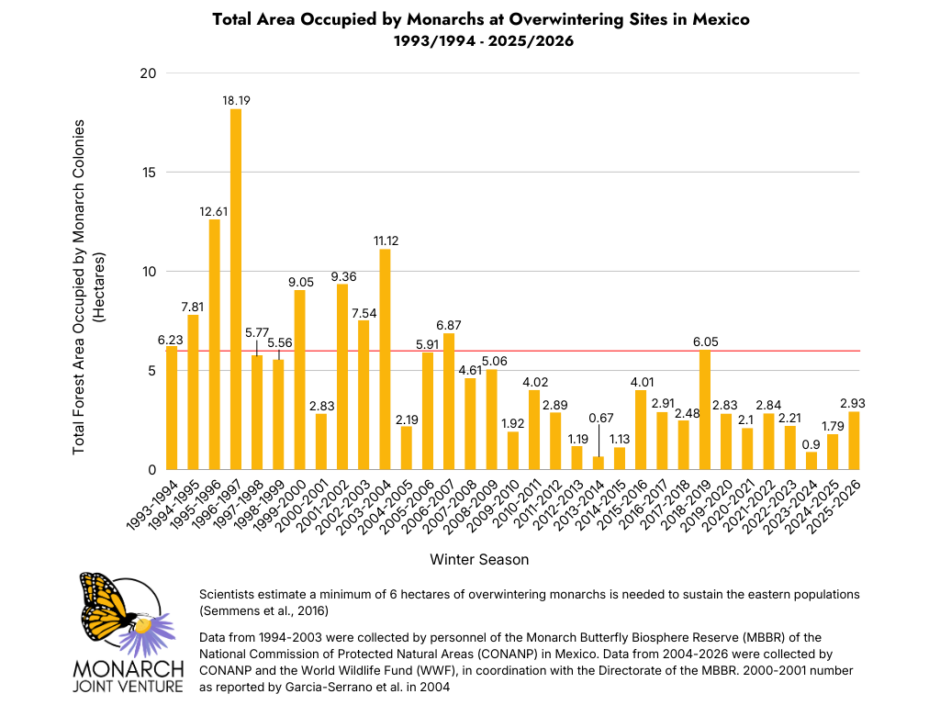
While a steady population is better than a declining population, most monarch scientists agree that long-term population resiliency will require a population that is fluctuating around an average of about 6 hectares, over twice the average of the past decade. This value would provide a buffer against catastrophic events that lead to large drops, as occurred between the winters that began in 1996 and 1997, 1999 and 2000, 2003 and 2004, and 2008 and 2009. Luckily, none of these drops occurred after an already-low year; if they had, the population might reach a value so low that it could not recover.
What’s happening now?
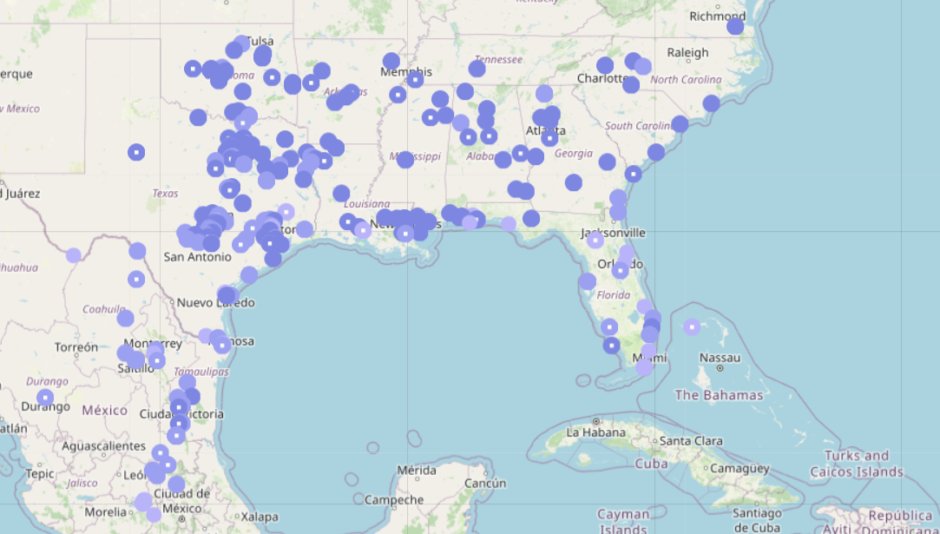
As of this writing, March 23, Journey North reporters have documented monarchs at about 37ºN, or about the southern borders of Virginia, Kentucky, Missouri, and Kansas. Because the map is changing daily, I encourage you to click on this link to see where they are when you read this report. Be sure to take some time to click on the dots with a small white square in them to see monarch pictures; this is especially exciting if you haven’t seen a monarch for several months! Monarch Larva Monitoring Project volunteers in Texas have begun to document eggs and even some larvae, the beginning of the first 2026 generation.
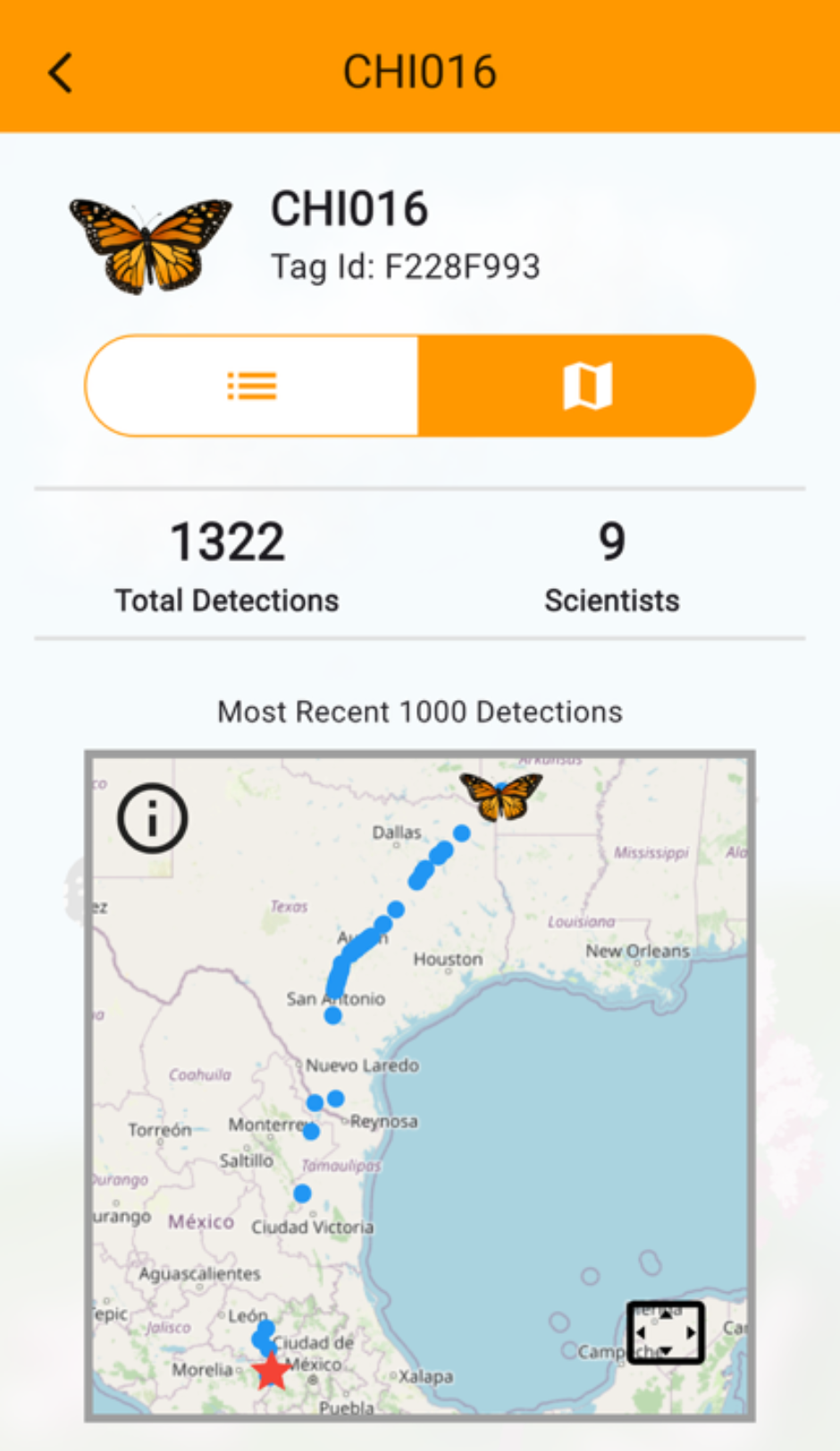
To follow the tracks of individual monarchs, the incredible new free Blu+ app (Project Monarch in your app store, from Cape May Point Science Center) uploads real-time observations from Bluetooth-enabled phones. This app has the potential to revolutionize our understanding of monarch movement! Stay tuned for more information, but here is a screenshot of a tracked monarch as a teaser. This monarch, named CHI016 (it was the 16th monarch tagged in the Sierra Chincua colony), was tagged with a small transmitter on February 11. This female weighed 0.496 g when she was tagged. Since then, she has moved 1067 miles into southwestern Arkansas.
Upcoming Opportunities
Monitoring
Monarchs are moving north! Help monitor them as they return from their winter stay in Mexico and lay the eggs that will become the first generation of 2026. Check out Journey North and the Monarch Larva Monitoring Project, or the Monarch Joint Venture Participatory Science handout for more ideas.
The Monarch Larva Monitoring Project team hosts live virtual trainings each spring. There is one upcoming live virtual training on May 12 for sites in the north, and several opportunities to work with local trainers. There are also self-paced online trainings available. The Integrated Monarch Monitoring Project is hosting both self-paced online training and virtual support sessions. These projects are closely related, and both provide detailed information on monarch densities. The IMMP collects more detailed habitat information that is useful to land managers and for analyses of habitat quality and availability. As a result, data collection takes longer. Monarch density data from both projects can be used in the same analyses.
On the Ground Conservation
Create Habitat: The Monarch Joint Venture has lots of great suggestions for preparing habitat that will be ready for monarchs when they return.
Back to all articles