
By Karen Oberhauser
Late summer (the second half of August and early September) is a particularly interesting time to observe monarchs in their northern breeding range.
Beginning on about Aug. 15, monarchs emerge from their pupae in diapause, a pause in development. It is a hormonally controlled state that allows insects to survive harsh but predictable environmental conditions. It can occur during the egg, larva, pupa, or adult stage, but in a single species, the stage is consistent. Monarchs diapause as adults, but other butterfly species can diapause in other stages.
Responding to cues that include both day length and sun angle, these adults do not become reproductive right after emerging. Unlike their parents and grandparents, who were ready to mate and lay eggs at three to five days of age, these butterflies will delay reproduction until the following spring. Instead of putting energy into mating, producing eggs and sperm, and laying eggs, they’ll store fat and begin the long migration to their wintering sites in central Mexico (eastern North American monarchs) and coastal California (western North American monarchs).
But in late summer, there are still plenty of monarch adults around who emerged before Aug. 15. These butterflies mate and lay eggs soon after emerging. They often move south to give their offspring a better chance of surviving upcoming fall weather conditions, but they won’t make it to the wintering sites. Thus, at this time of year, observers in the north might see eggs and larvae on their garden milkweed, females laying eggs, males chasing females, migratory adults flying southward, and, if they’re lucky, a monarch roost—all on the same day!
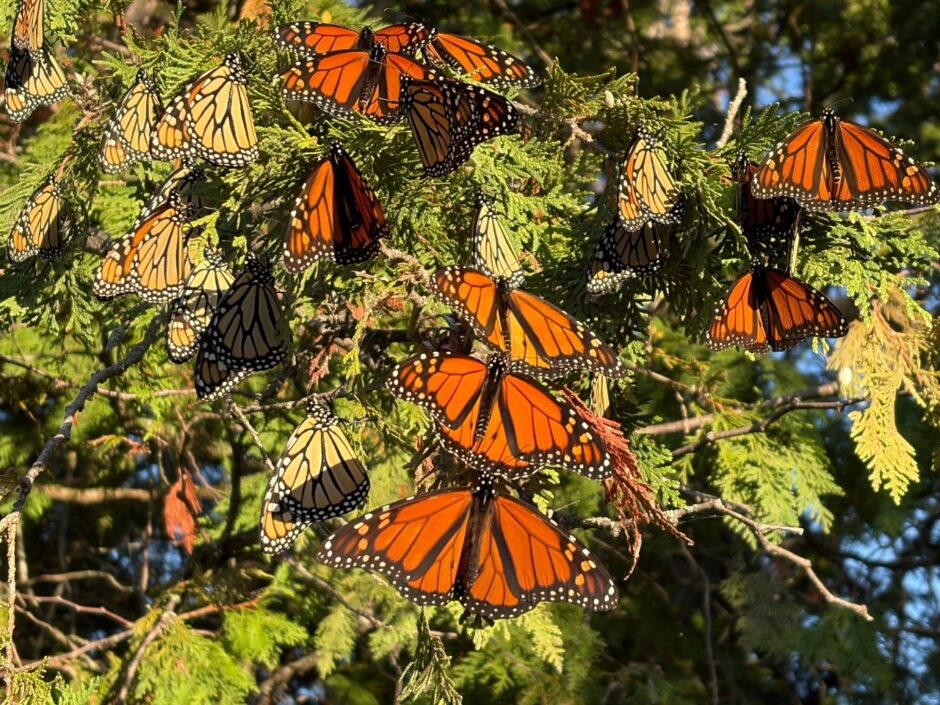
You can keep track of what’s happening with monarchs by checking out Monarch Larva Monitoring Project graphs to see the density of monarch eggs and larvae in your state and Journey North fall roost reports. As of Sept. 14, there have been reports of roosts as far south as Nebraska, Missouri, and Kansas. The photo below shows an impressive aggregation in Peninsula Point, on Michigan’s Upper Peninsula.
How did the breeding season go?
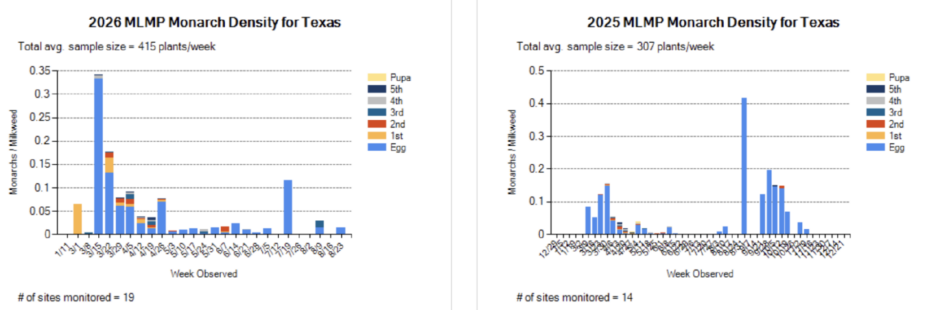
Spring densities in the south, as documented by MLMP volunteers, in 2026 were similar to 2025 (see the Texas graph below).
The first eggs observed in northern states are laid by the first generation of the year that comes up from the southern U.S., so egg and larva densities in May and early June reflect spring densities in the south and success during the northward migration. The year 2026 started out with low monarch densities in the north in the first half of May, but picked up in late May. June and July values were similar to 2025 (the graph below shows Wisconsin data, and patterns in other northern states are similar), and volunteers documented strong egg and larva densities throughout August.
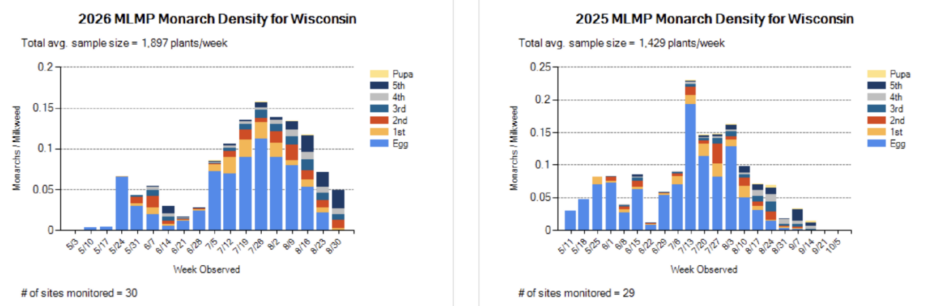
The late summer/early fall peaks in southern sites document eggs laid by reproductive monarchs moving south from the northern breeding range (see above section), or monarchs that break diapause during migration. Monarchs can break diapause if they’re in poor condition or if they encounter milkweed in good condition.
For more detailed comparisons across years, see graphs on the MLMP website.
What’s ahead for this year’s monarchs?
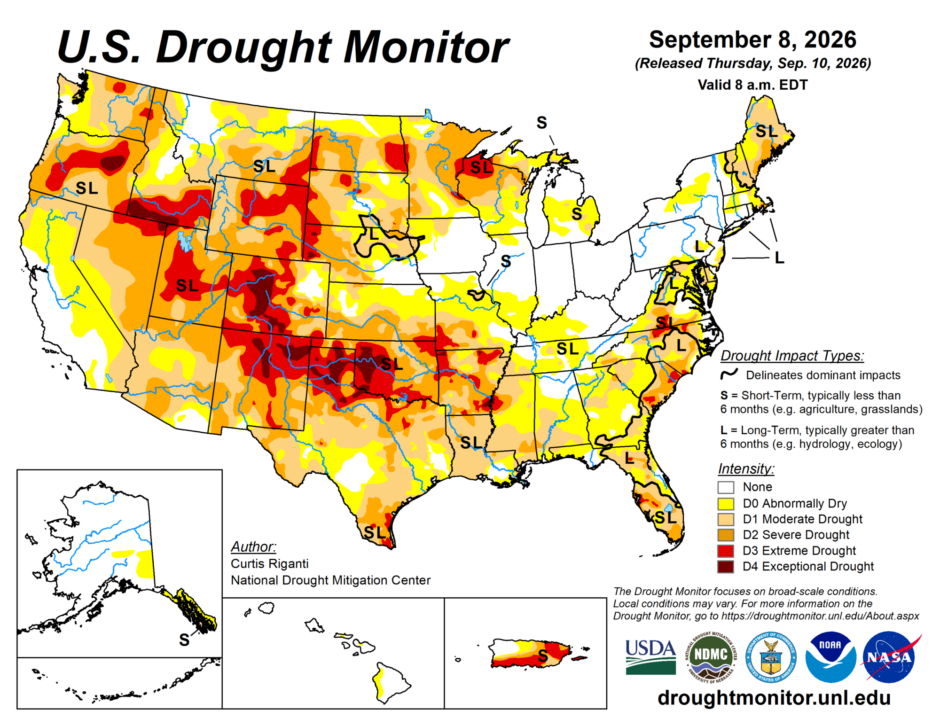
Because monarchs need to eat as they migrate south, migration success depends on nectar availability. Plants produce less nectar when conditions are dry. The current drought map for the U.S. below shows a dry outlook as monarchs move southward. Wet conditions along rivers and low areas will be important sources of the nectar needed to fuel the migratory flight.
Thanks to Journey North and Monarch Larva Monitoring Project volunteers for providing the above data, and the U.S. Drought Monitor team (the National Drought Mitigation Center at the University of Nebraska-Lincoln, the National Oceanic and Atmospheric Administration, and the USDA), who provide important statistics on drought conditions throughout North America.
If you’d like to help monarchs, one of the best things you can do is help provide habitat for them. Check out the Monarch Joint Venture webinar coming up on September 22: Seeds of Change: How Volunteers Power Prairie Restoration.
Providing data for the MLMP and other monarch citizen science projects is another great way to help monarchs. Thanks for all that you do to help us understand monarchs, provide habitat for them and other pollinators, and engage in more effective conservation for this amazing species.
Back to all articles